DHC-6 Twin Otter
Operated by

About the
DHC-6 Twin Otter
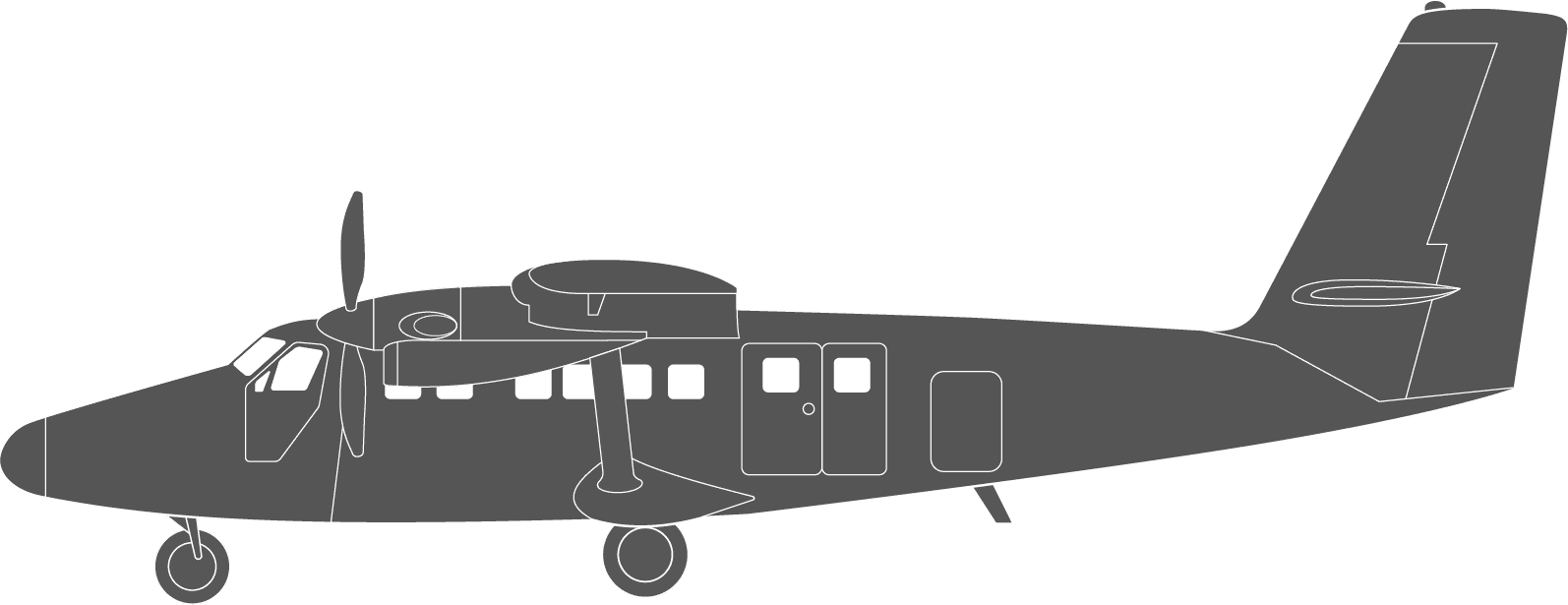
The DHC-6 Twin Otter is a rugged twin-engine turboprop known for its exceptional short takeoff and landing performance. Designed for versatility and reliability, it operates from challenging airstrips while providing practical passenger transport for small groups.
Read More
the Bird
A regional airliner seating 10-18 passengers, with 775 nm (1,435 km) of range and a 180 kt cruise.
Cabin Height
1.49 m
4.9 ft
Cabin Volume
10.6 m³
375 cu ft
Seating
10-18
Double club, 4 fully berthable
Baggage
2.55 m³
90 cu ft
Technical Specifications
Specification
Metric
Imperial
Performance
High-speed Cruise
333 km/h
180
Certified Ceiling
5,926 km
3,200 nm
Take-off Distance
366 m
1,200 ft
Cabin & Capacity
Passengers
10-18
Cabin Length
5.64 m
18.5 ft
Cabin Height
1.49 m
4.9 ft
Baggage Volume
2.55 m³
90 cu ft
Flying the de Havilland Canada DHC-6 Twin Otter
The de Havilland Canada DHC-6 Twin Otter is a regional airliner built in Canada, flown by a two-pilot crew and configured for 10-18 passengers. It covers up to 775 nm (1,435 km) in a single leg — roughly 4 hrs 30 min in the air — cruising at 180 kts (333 km/h) and certified to 25,000 ft (7,620 m). The cabin measures 18.5 ft (5.64 m) long, 5.3 ft (1.62 m) wide and 4.9 ft (1.49 m) high, with 90 cu ft (2.55 m³) of baggage space.
How many passengers does the de Havilland Canada DHC-6 Twin Otter carry?
The de Havilland Canada DHC-6 Twin Otter seats 10-18 passengers. The exact number depends on the cabin layout chosen by the operator, and the aircraft is flown by a two-pilot crew.

What is the range of the de Havilland Canada DHC-6 Twin Otter?
Maximum range is 775 nm (1,435 km), which works out to around 4 hrs 30 min in the air at a typical cruise speed of 180 kts (333 km/h). Payload, routing, weather and reserves all shorten that in practice.
How much runway does the de Havilland Canada DHC-6 Twin Otter need?
Takeoff distance at maximum takeoff weight is approximately 1,200 ft (366 m) at sea level in ISA conditions. The aircraft is certified to a ceiling of 25,000 ft (7,620 m), above most airline traffic and weather.
Upgrade your travel experience. We craft air transportation solutions daily to meet diverse requests. Our team ensures the perfect aircraft and service for both.
Cabin & Comfort
Standard
On Request
Refreshment Centre
Wi-Fi
Power & USB
Climate Control
In-Flight Entertainment
Cabin Attendant
Sleeping Capability
Aircraft Capabilities
Standard
On Request
Pressurised Cabin
Enclosed Lavatory
Stand-Up Cabin
Flat-Floor Cabin
In-Flight Baggage Access
Short-Runway Capability
VFR Capability
With access to more than 3,500 private jets worldwide, we source aircraft across global markets through our trusted operator network. Suitable options range from helicopters and light jets to long-range business aircraft, depending on mission requirements.
